December 26, 2025
Artificial Intelligence (AI) has grown over the past few years and has become a front and centre component of live events. AI is also becoming essential in elevating event experiences as audience expectations evolve for greater interactivity, real-time engagement and seamless logistics.
The use of AI is crucial in many aspects of the industry, including on-stage conversations during live events. In this article, we’ll explore how we used conversational AI on-stage at the Standard Chartered Malaysia 150th Anniversary event, why AI is becoming essential in live events, the benefits it offers, and the challenges it poses.
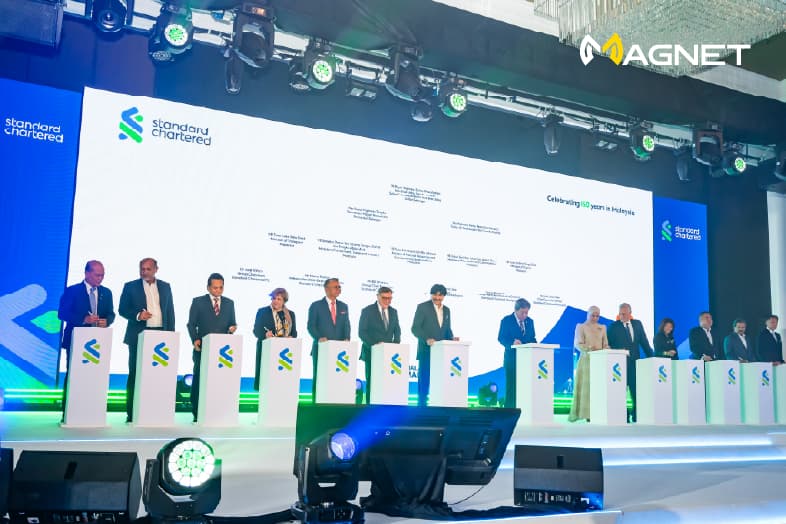
During the 2025 Standard Chartered 150th Anniversary event, Mark, Managing Director and CEO of Standard Chartered Bank Malaysia Berhad, unveiled their very own AI, Scarlett (SCPT), a conversational AI system we deployed as part of the on-stage flow to its real-time intelligence.
Scarlett was asked to question a person in the audience and to identify who that person would be. After conducting some on-the-spot search, she called on YB Tengku Zafrul, the Minister of Investment, Trade and Industry Malaysia to be on the stage.
Scarlett served as a live moderator and intelligent assistant for Standard Chartered, so instead of a traditional two-person interview, the AI facilitated a real-time conversation flow where it posted a question to YB Tengku Zafrul, “With the latest development in global tariffs and the looming risk of a global trade war, could you share your views on the impact this may have on the country’s trade and investment?”, it could also reiterate the live feedback it received from the minister as the conversation was taking place.
The events industry is seeing increased demand for AI solutions. Below are some reasons why AI is becoming essential in live events:
As we dive deeper into the digital world, event attendees are expecting more than just passive presentations. These days, they want dynamic interactive experiences, instant feedback, inclusive communication such as live captions and translations as well as immersive experiences which can all be delivered by AI.
The use of AI automates many manual tasks, such as content generation, scheduling, and live translation, helping reduce workload so staff can focus on other important tasks, such as creativity and high-touch engagement.
Today, many events are hybrid or multinational where attendees may speak different languages, come from various time zones or require different accessibility features. These modern events can be scaled more easily by AI than by human-only staff, making AI an essential in live events. AI can also handle thousands of simultaneous interactions which makes them suitable for large events.
With real-time analytics, data analysis, usage tracking and attendee interaction data, organizers can better understand audience behaviour, adjust flow and plan more efficiently. This also helps them in important decision-making.
Below are some key benefits of integrating AI into event programs:
One of the advantages of integrating AI into event programs is the AI chatbots that can handle questions from attendees in real time. This ensures faster responses than human staff, especially during large events.
It also enhances attendee engagement throughout the event by providing instant support. These chatbots can provide your audience with quick and accurate information, ensuring a smooth operational flow during the event.
When it comes to language barriers at events, AI can help with live captions and translations that break down language barriers, making it easier for events to cater to international and multilingual audiences.
AI is also transforming the events industry by providing attendees with adaptive content and personalized recommendations in real time after analyzing their data, preferences, and behaviours.
The events industry has grown over the years and has included immersive and mixed-reality experiences by using AI with augmented reality (AR) or virtual reality (VR). Events can deliver engaging, immersive storytelling, blending live performances with virtual elements for a greater experience, exactly what the audience is expecting.
Apart from real-time responses and enhanced interactivity, AI can help with consistent messaging and branding including helping with generating presentation content, marketing copy, social media posts, slides as well as design assets, ensuring there is a consistent branding that can draw attention to your brand. The use of AI reduces manual workload, ensuring content and visuals are delivered on time and also reduces human-made errors.
AI helps in streamlining event management, from scheduling to attendee communication and data collection, ensuring the entire event flows seamlessly from start to end. AI automates many logistics which leads to smoother workflow, fewer errors, and provides more time for creative planning.
Using conversational AI in live events is a great way to interact with your audience and keep them engaged as well as entertained. However, the use of AI in live events comes with its share of challenges and technical considerations. Here are some challenges we faced and how you should address them:
AI is becoming smarter and more advanced, so the use of AI for on-stage conversations during live events is a great way to impress your audience. Attendees in this digital world are expecting more than just passive presentations, and conversational AI can help transform on-stage interactions, making it more interactive, engaging and efficient.
If you’re planning your next conference or corporate event, consider integrating AI-driven conversational systems like chatbots, AI emcees, live translations, or captions into your program. With the expertise of The Magnet Group, an award-winning event management company in Malaysia, you can take your event to the next level with AI. Get in touch with us today!